Mostrando postagens com marcador About Kimono. Mostrar todas as postagens

14/01/2016

Kimono Q&A: Wedding Kimono

From Danye-Angel on DeviantArt:

(...)"I was hoping you could help me out with wedding kimonos, please? I keep researching and I can't figure out how many kimonos does a bride wear from the engagement to the end of her wedding day. Some say two, others say three. X. X 
 Also, someone told me that the bride usually wears a flower with a personal meaning in her hair, is that correct?? If they have some common flowers, do you know which are, please?? And which accessories do they use?"(...)

----------------------------------------------------------------------------------------------

Hi, Danye-Angel. Your doubts are understandable. Wedding kimono are variate and full of details, so this is a complex theme. I'll do my best to help clear it up a bit!^^

Regarding the engagement, there is no specific kimono related to a woman being fiancée. She would keep wearing her usual kimono, including long-sleeved furisode, until she got married.

For the wedding ceremony, the first thing to consider is that, like in western-style weddings, the bride and groom can go for a very traditional style, or choose a more modern one. Let's start from the most traditional Japanese-style women's wedding garment still in use today: shiromuku.

~ ~ ~ Shiromuku: Pure White


The shiromuku (translated pure white) wedding ensemble has been worn by brides in shinto wedding ceremonies since the Muromachi period (1336~1573). All the garments and accesories are white, and usually feature auspicious motifs like cranes, pine and bamboo, tortoises... - all also in white. This color is a symbol of a bride's willingness to be "painted" with her new family's standarts and ways.

The full shiromuku ensemble includes white undergarments, a furisode with trailing hem called kakeshita (or shiro-kakeshita, "shiro" meaning white), white obi (usually a super-gorgeous maru obi, or less expensive, yet also highly formal fukuro obi), white obi-age and obijime, and a heavily-decorated, embroidered over-kimono worn loose over all, named uchikake (or shiro-uchikake). The bride also wears tabi socks and zori sandals, and, as main accesories, a sensu folding fan, a small kaiken* knife, and a brocade purse called hakoseko.

*This comes from samurai women, who used to get a kaiken on their wedding day, and always kept it on their obi, for self-defense. I think the kaiken nowadays is fake, though, just for tradition.


 In this detail, the rich white-on-white motifs of shiromuku are visible. Please notice the hakoseko tucked in the bride's eri (collar) and the kaiken inside a fabric tied with silk cord, tucked in her obi. Cut from an original photo from Studio Aqua.

...About the hair. Traditional brides wear a wig styled in Edo period shimada style, adorned with kanzashi (not the silk ones maiko wear, though... see their style below). Then they cover it with either a special hat called tsunokakushi, or, while outdoors, a hood that works similarly to a western's bride veil, named wataboshi.

 A traditional bride wearing the tsunokakushi hat over shimada wig. The kanzashi (and in this case, the tiny detail of red inside the front hat bow) are the only colored details. Photo from Takehiro Misawa Photograph Office.

The full shiromuku look is both gorgeous and delicate. The uchikake is lined and padded so it trails beautifully, but because of that it's also quite heavy! This photo shows a bride dressed in this super-traditional shinto wedding style, with shiromuku and wataboshi, from Juin Perle. You can see the sensu in her hand, and the silk danglings that decorate the kaiken tucked in her obi.

Even with shiromuku meaning "pure white", it's very common to also see it featuring hints of red in some details. Since red is a classic auspicious, feminine-related and neutral (yes, neutral!) color in kimono culture, its presence there is still in very traditional style, just like all-white shiromuku.

Traditional brides wearing shiromuku with hints of red. It's specially common to see this color peeking from white as in here, inside the wataboshi, and in the garment's lining. Photos from Hayato Blog (left) Takehiro Misawa Photograph Office (rigth).

~ ~ ~ The Gorgeous Iro-Uchikake


Starting from the Edo period (1603-1868), a new wedding garment came for brides from wealthy and noble families. After the wedding ceremony, for the reception, they would change their all-white shiro-uchikake for another uchikake outer-garment, called iro-uchikake (iro meaning "color").

Iro-uchikake features the same auspicious kind of pattern and rich brocade we see on shiro-uchikake, only this time very colorful. Red is the most traditional base color for this kind of wedding kimono, but other tones like gold and pink are also common. Slightly more modern designs feature all kinds of color, preferably deep, rich tones like deep purple or green, and even turquoise.

A super-traditional red iro-uchikake with auspicious motifs, and another a bit more modern, deep purple and pink with sakura (cherry blossoms) as main pattern theme. Notice the kanzashi, also less traditional in the purple uchikake photo. Both from K-Bridal.

~ ~ ~ The Elegant Hikifurisode


Apart from shiromuku and uchikake, another classic kind of bridal kimono is the hikifurisode - "trailing furisode", also called hanayome furisode ("bride furisode") or kakeshita (just like in shiro-kakeshita, only without the "shiro" for "white"). Hikifurisode is typically an o-furisode* with a small trail, worn without a fold at hip-height - different from standart furisode, which, like most female kimono, is folded so the hem will go almost up to the ankles.

*All furisode have long sleeves, but they can be divided in ko-furisode (usually only worn with hakama, for graduation ensembles. The sleeves are 75-87cm long), chu-furisode (standart type, with sleeves of 91-106cm), or o-furisode (the more formal, with sleeves of 114-125cm).


Standart o-furisode (left) and bridal hikifurisode (right). Notice the absence of the fold at the waist/hip line on the bridal garment, as well as the padded trail and bridal accessories (sensu, kaiken and hakoseko). Pretty sakura-themed furisode from K-Bridal, and elegant hikifurisode from Ogiya Wedding Salon.

Hikifurisode started to be worn as bridal garment by samurai women in the late Edo era, and is popular today as a lighter (and probably less expensive) alternative to shiromuku/uchikake. More traditional brides may use it as a third change of clothes during their wedding day celebrations, after shiromuku (for the ceremony) and uchikake (for the reception).


~ ~ ~ Modern Twists!


Finally, after knowing all the traditional garments, it's time to see more contemporary-born variations of bridal kimono! There are "modern twist" versions of all of them, and even new shapes altogether. The possibilities are almost endless, so I'll just brush over a few styles!

Today bridal kimono can range from super-traditional black hikifurisode with classic motifs and tsunokakushi (from Juin Perle) to crazy leopard-print butterflies and foofy ruffles uchikake (from Scena D'Uno) - and every style in between! ;)

About the hairstyle... Both traditional bridal headwear tsunokakushi and wataboshi used to symbolize a bride's obedience to her husband (specially the tsunokakushi, which was worn to hide the brides "horns of jealousy"). So, maybe for this, many japanese brides today choose not to wear them, and go with just the shimada wig, or a more modern hairstyle instead.

This is probably where enter the flowers you mentioned - it's indeed quite common to see modern japanese brides wear their hair up on a formal bun, adorned with flower kanzashi, or even natural flowers. The styles go from soft and discrete to wild, giant bouquets, so I think it's all up to each lady's taste on her special day!

Examples of modern bridal hairstyles paired with shiromuku and uchikake.The first on the left is based on traditional nihongami (japanese hairstyles), but has the boldest flower arrange! The other two show clear western influence, in a variety of color schemes. They all look so pretty! Left photo from Statice Dress, right from Mimatsuya. Sorry, couldn't find the source for the middle one!

Some brides go for a classic shiromuku with new hints of color - specially pink - or made of other fabrics instead of/ mixed with silk. Organza and other light, see-trough fabrics are also very popular, with both all-white ensembles and colorful uchikake.

A white-and-pink modern "shiromuku"...

Lovely translucent iro-uchikake in pastel tones...

 Pink and white floral iro-uchikake. From Bienveil.

These designs from Scena D'Uno mix shiromuku with western-like veils...

Other recent style can be seen in Yumi Katsura's bridal designs, that mix hikifurisode and uchikake with a western-like long trail. I'm usually not a fan of changing kimono shapes (as, for me, it usually just stops looking like kimono), but I find this change in particular quite lovely, as the original proportions of the kimono are kept - just with some extra trail, which looks plain gorgeous!

A Yumi Katsura bridal design. Super long-trail deep blue hikifurisode with peonies and golden motifs. The layered-like hem and eri (collar) are a reference to the multi-layered kimono of old times, and the bride's hair is styled in traditional japanese way. The modern, intricate and delicate kanzashi is simply amazing!

A super-long trailing reinvented shiromuku, with traditional japanese tsunokakushi, 
modern hairstyle and western-classic lace! By Yumi Katsura.

...Can you tell I'm a fan of Yumi Katsura? Notice the round bouquet - japanese-style bouquets are often ball-shaped, tied in colorful cords and hanging like a flowery purse. This one is midway to a western-style, though...

A more classical japanese-style bouquet. So cute! 

 And this mixes the traditional "shiromuku + red" and japanese ball bouquet style with modern elements - and fruit! - for a chic, trendy look. The bridal kimono possibilities are endless!

...So, this is the basics about ladies' wedding kimono! I hope this (not so small) article helped you a bit, Danye-Angel! Thank you for your question, it was a lovely subject to research - so many pretty kimono photos! Any other doubts about wafuku, don't hesitate to ask! ^^


05/08/2015

Kimono Q&A: Concubine/Consort Garments

From Orangenbluete on DeviantArt: "Can you tell me which kind of "Kimono" a concubine of a high ranking person (Shogun, Tairo) wore?"

----------------------------------------------------------------------------------------------

Hello! The garments of a concubine/consort of high-ranking men varied according to two factors: the time period and if they were civil or military aristocrats.

In Heian period (794-1185), the civil aristocracy (kuge) from the Imperial court retained political power - therefore, they were the high-ranking class. Court ladies (including wives, consorts and daughters of court officials and noblemen) wore junihitoe, ("12 layered robes", althoug the actual number of layers reached 20 in some periods). You can read/see more about junihitoe here, in this chart from my DeviantArt gallery.

A modern replica of Heian period junihitoe.

From the end of the Heian era, the military aristocracy (buke/samurai) gained more and more status, and the political power shifted towards figures like the shogun and provincial lords (daimyo), from the buke class. Samurai ladies wore simpler garments than civil/kuge ladies. During the Kamakura-Muromachi-Sengoku eras that followed, they wore kosode combined with thin obi and a few layers of outer robes (uchiki) over it - no more hakama or mo. Kosode was the "grandpa" of modern kimono, wider and with short sleeves, sewn to the main body - like in modern men's kimono.

This style with kosode+thin obi+uchiki was worn by high-ranking samurai ladies (including wives, consorts and 
daughters of the shogun and daimyo) during about Momoyama to Sengoku periods. The hair, as in Heian era, was worn 
long, loose or tied at back in suihatsu taregami style. Photo from Jidaya Arashiyama.

During the Edo period (1603-1868), the kosode slowly became less wide and the brocade/dying techniques advanced, transforming towards the kimono we know today. There was a lot of variation in fashion during the centuries. But, for an example of this period... At the XVIII century, wives and consorts of shogun/taiko/daimyo used to wear koshimakitsugata, i.e., "koshimaki style"- an over-robe tied at waist. Althou high-rank samurai ladies used to tie their uchiki at waist during summer since the Muromachi era, at the height of the Edo period this "evolved" into a specially flamboyant style, with a special obi to keep the uchiki's sleeves open while the koshimaki was worn.

From left to right: Sengoku period koshimaki style, worn on summer, and Edo period-style koshimaki. In Edo period, the special obi (koshimaki-obi) kept the sleeves open, creating a "wide wings" effect on the waist. Photos from the Kyoto Costume Museum.

 As typical from the Edo era (specially in its later period) straight low-tied hairstyles often changed into complex buns. Several styles existed, and were worn by specific class of women. Some hairstyles were for commoners, other for rich merchants, other for geisha, other for noblewomen, etc... This is not my specialty field, so I won't say much about it... ^^; But you can check out some examples of nihongami (traditional japanese hairstyles) and their use in this deviantart gallery.

A TV drama's costume of a lady from the Ooku - a term that despicted an isolated area of the castle were 
lived all women related to the shogun (or powerful daimyo), such as their mother, wife, consorts/
concubines and daughters. This costume is related to the Edo period.

Meanwhile, civil court ladies from the Imperial palace still wore very traditional junihitoe for formal occasions, even during much later periods than Heian. Junihitoe worn by Imperial family ladies in XIX century had little differences compared to Heian period ones. The most visible change was the hairstyle, called osuberakashi, that had a high "lamp-shape", and was worn with golden hair ornaments.

Heian era junihitoe (left) and end of Edo era junihitoe (right). The most significant change in Imperial 
ladies' formal garment during these distant periods was their hairstyle.

A close-up on Edo period osuberakashi hairstyle.

...I hope this helped at least a bit on answering your question, Orangenbluete! Sorry it's just a quick overview, but this is a quite wide topic (which I'm not an expert at, I must admit! ^^;). Any other questions or if you're interested in more about a specific time period for consort-concubine garments, feel free to ask!


24/07/2015

Kimono Q&A: Crests/Kamon and Kimono Formality

From Raxiell on DeviantArt: "I have a question as well /o/. In your tutorials, you say the outfit 'become more formal if crested'. What really is crested, how do I identify it? Sorry if it's a dumb question... '-'."

----------------------------------------------------------------------------------------------

It's not a dumb question at all! Please don't worry!

"Crested" means the kimono has crests on it. A japanese crest is called mon, and, as in western heraldics, represents a family, group, etc. A mon that specifically stands for a family (and not an organization/store/other kind of group) is called kamon. So a crested kimono features little symbols of the wearer's family, kamon, and therefore, is more formal.

The kamon in a crested kimono can be 1, 3 or 5. They are always put on the same position:

- 1 kamon (quite formal): under the eri (collar) at the back. 
- 3 kamon (formal): same as 1, plus both sleeves (over the elbow, more to the back)
- 5 kamon (super formal): same as 3, plus both front sides of the eri.

Super formal kurotomesode features all 5 kamon. Less formal kimono can feature no kamon, just the one at the 
back of the eri or that plus the ones at the sleeves. Beautifu kurotomesode found on K-Bridal.

Some kinds of kimono can have their formality "pushed up" by adding kamon (see the articles on kimono types for more details on each case). Other, like yukata, are too informal and never feature kamon. Why? Think that it's like wearing stilettos and a minaudière (you know, those tiny sparkly evening purses) with your gym sweater and shorts. It would just look unfitting together. ;p

I hope this answers your doubt, Raxiell! Thank you for your question! ^^


21/09/2014

Wafuku Question: Michiyuki

I was asked by Orangenbluete on my DeviantArt account about the kind of "over-kimono" that the lady with blue hair wears in this picture:

http://th00.deviantart.net/fs71/PRE/i/2014/264/f/c/natsume_yuujinchou_full_763300_by_orangenbluete-d7zz5j9.jpg 
(from the anime Natsume Yuujinchou... I didn't watch it, though)

This is a traditional "kimono coat" called michiyuki. It's meant to be worn when going out in the street, to protect the kimono from getting dirt or wet, and also to make the wearer warmer. Michiyuki can have different lenghts, from short, waist-line ones to others as long as the kimono itself. It is usually plain color, or has discrete, simple patterns - which makes sense, since it's made to suffer more wear than the kimono underneath it.

A red michiyuki, closed by buttons.

A dark, plain color michiyuki.

Different from haori (another traditional kind of kimono over-garment) michiyuki has a square neckline, and is usually closed by buttons. It's also mostly made for women - while haori was a male outfit that ended up having female version too after Meiji period (1868-1912). Also different from haori, michiyuki is always worn closed.

Michiyuki (left) and haori (right). Notice the different collar shapes. Also, haori is tied with a cord 
in middle chest and worn open, while michiyuki is closed by side buttons, and always worn closed.

Also, be careful not to confuse michiyuki with dochugi, yet another type of going-out over-kimono. Dochugi is worn in the same way and occasions as michiyuki (and also closed), but the collar and sleeves are just like of a kimono. Also, it is fastened by cords at the side.

Maiko-san wearing michiyuki over her kimono (see the square collar?).
Photo by Walkkyoto on Flickr.


Geiko-san wearing a dochugi over her kimono. Notice how it's tied at the side.
Photo from Walkkyoto, on Flickr.

Michiyuki and dochugi have a quite old-style feel to it (as you can see, they're worn by geisha and maiko, so, they're very traditional wafuku). These garments reminding me of the first half of the 20th century.. - althou I'm not sure when they first appeared, so their early origins might be a bit older. They're both very fit for rainy or snowy weather.

I hope this cleared things up about michiyuki (and a bit of other kimono overgarments). Thank you for the question, Orangenbluete! ^^


22/08/2014

Types of Kimono - Yukata

 So, after a long hiatus, I'm back on my kimono tutorial posts! 
And today we'll cover the last "basic" type of kimono, the yukata.

The term yukata comes from "yukatabira", or "bath underclothes". As one may probably guess, this is the most informal kind of kimono, being used after the bath (commonly at onsen hot spring resorts), as well as for sleeping, relaxing at home or for attending at summer festivals.

Dark blue + white are the most classical colors for yukata
(also paired with light blue in this yukata from Kimonomachi).

Due to it's common use in summer, yukata is often described as "a summer kimono". Althou that is not completely wrong, it's also not ideal as a definition, because not all summer kimono are yukata.

Yukata are made of light cotton, with no lining. Other summer kimono are also characterized by lack of lining, but are made from other materials. Kimono summer fabrics, which include gauze-like fabrics like ro and sha silks, are called usumono.

 Usumono tsukesage from K-Bridal. The gauze-like fabric calls for adequate underkimono (since it shows through). In spite of being transparent and unlined, this is a formal tsukesage - only, made for wearing during the heigh of summer. Therefore, it's not yukata!

Apart from the different materials, yukata are also worn in a very relaxed, informal way: often without a juban (underkimono) or tabi (wafuku traditional "socks"). Other summer kimono, on the other hand, may even be made of light, transparent fabrics, yet they are worn more formally, with juban and other usual kimono accessories.

 From left to right: yukata from Soubien, and usumono tsukesage, from K-Bridal. Both summer kimono, but with different 
formality levels. The lady in yukata doesn't wear a juban, obi accessories* or tabi - all elements present in the other lady's 
more formal kimono. Also, the yukata patterns themselves are simpler, repeating all over the fabric in a way that 
resembles a komon - all signs of a casual style in kimono aesthetics.

Different from other kinds of kimono this tutorial covered so far, yukata is not exclusive for females. There are also yukata for men - althou, they have a different shape than the female version, with shorter sleeves. There's also no age or marital status restrictions for yukata, which means, everyone can wear it, from little kids to granny and grandpa. The differences will be in the colors and motifs: as usual in kimono aesthetics, female kimono tend to be more colorful than male kimono. Also, brighter tones and bigger patterns are commonly worn by the youger generations, while more mature wearers go with subdued, discrete fabrics.

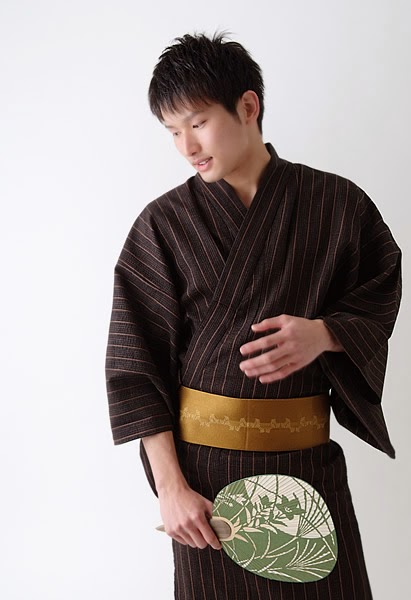
Male yukata, featuring dark, sober colors - with a youthful touch given by the golden 
obi. The lack of a juban fits a super-casual look. This kind of  fan, called uchiwa
is a traditional summer accessory. From Kimonomachi.

http://media-cache-ak0.pinimg.com/originals/ef/fb/b6/effbb693b276e1485cf0c9f32c4b5b2f.jpg
 Kids wearing yukata. Notice how the girl's sleeves are longer 
than the boy's - a shape difference in the female and male yukata.

When using yukata as a sleeping garment, one will simply tie it with a narrow belt, of the same fabric from the yukata - like in western bathrobes. To wear it in public, thou, it's appropriate to tie it with a proper obi.

Beign very informal kimono, yukata are worn with informal obi as well. For tying a female yukata, a nagoya-obi with simple design, a half-leght casual hanhaba-obi, old-fashioned chuya-obi, or even super light heko-obi can all be used. For male kimono, there are only two kinds of obi - more formal kaku-obi, and male-designed heko-obi. Both can be worn with yukata, althou, I think good sense in choosing a casual designed kaku obi is required, so the combination won't look odd - same as with female nagoya-obi.

As for musubi (obi knots), the simple bunko and cho musubi are maybe the most popular knots for wearing with yukata. Another common option would be kai no guchi musubi, which is fit for both female and male obi. The classical taiko would be a way too formal musubi for yukata, but it's floppy casual "sibling", tsunodashi musubi (also known as ginza musubi) can be worn.

Yukata worn with bunko musubi (left) and cho musubi (right). The main difference 
between these knots is the bow position, horizontal in bunko and vertical on cho.

http://media-cache-ec0.pinimg.com/736x/06/65/35/066535e33879097a887e681a33a59518.jpg
Couple in yukata. The lady wears what looks to me like a tsunodashi/ginza musubi variation (?). 
The gentleman wears kai no guchi musubi. Photo: Yoann Gruson-Daniel, in Kimonobsession 47.

 http://img.enfactory.jp/profile/pf/img/library/l/1324471499.jpg
 Another kai no guchi musubi, this time worn by a lady. Since female 
obi are wider than male obi, the knot ends up with a bigger size.

Besides those musubi, yukata also allows one to simply tie their obi in non-traditional ways - specially when wearing heko-obi, which, different from others, is not made from stiff/firm but very soft fabric. This creates a variety of floppy, informal knots that I like to nickname foofy mess musubi (not a proper kitsuke term, thou! lol ;p).

Maybe this could be considered a bunko or cho variation (?), but it's one 
of those heko-obi floppy knots I just like to call "foofy mess musubi".

Some girls and young ladies also add a second obi when wearing yukata (or, sometimes, komon). These are short, decorative, often gauze-like sashes named puchi obi, or puchi heko-obi, and are meant to be worn over a regular obi. The addition of a new layer of color and texture, and another bow, makes the overall look to be more frilly.

This lady wears a transparent puchi obi over her pink obi.

A puchi obi tied in front over the obi, in a bow or flower shape, 
makes a flashy accessory choice for yukata. From Cream Dress.

And this closes the basics about yukata, as well as the basic Types of Kimono topic! For the next topic of these tutorials/articles, I'll be holding a poll in my DeviantArt page, so vote on your favourite subject!

* The obi accessories, as obi-age, obi-jime and others will be explained later on this tutorial. ^^


This is also my 100th post on HANAMI! ^^
A big thank you to all my followers!
I hope this blog will go on for many more posts!


17/12/2013

Types of Kimono - Komon

After talking about Edo komon, a specific kind of komon almost as formal as iromuji, our next subject is komon.

As mentioned in the previous "Abou Kimono" post, komon is a kimono with repeating patterns all over the fabric. Althou the literal meaning of komon is "small prints", these patterns aren't necessarily small, just repeated - different from a houmongi, for example, were are patterns all over the garment, but they don't have a repetitive look.


A pink komon. The floral pattern is repeated all over the garment.

For left to right: tsukesage, were motifs are repeated, but only in few spots over the kimono; komon, with repetitive patterns all over the garment; and houmongi, with lot of patterns arranged in non repetitive fashion (in this case, a flowing "stream" over the kimono, a common arrange also for furisode motifs).


Komon patterns can vary a lot: full or sparse, geometric or not, arranged in stripes or "splashed" all over the fabric, big or small, bright or discrete... As usual in kimono aesthetics, the bigger the patterns the younger is the look (and so should be the wearer).


 Two komon with an autumn feel.

Sparse-patterned, delicate komon, and bright crowded komon!


A komon with geometric motifs, and one with flowers organized in vertical "stripes". 
This style of pattern arrange is very common in komon (lol, pun not intended... x_x). 


Komon is considered an informal kind of kimono, suited for casual parties, walking in town, go shopping or hang out at home. So, they normally don't have kamon (crests), which add formality. Some komon, thou, can be considered semi-formal* depending on the pattern and fabric. Silk and synthetic fabrics are considered less casual than wool, for example. Gold or silver accents on the motifs also make a komon less casual, as well as the accessories choice.

Being very versatile depending on it's motif and fabric, komon can be paired with almost any kind of obi, from fukuro obi (specially if the obi pattern is casual) to nagoya obi, hanhaba obi, chuya obi or even the super informal heko obi**. It really depend on the combination look and the situation. About musubi, I've seen komon paired with many types, too, which is not surprising for a kind of kimono with such variate formality status... See below (all worn with komon):


The classical taiko musubi...


Tsunodashi/ginza musubi, a less formal variation from taiko, from Soubien...


Bunko musubi, a horizontal high bow... There's a chance this may not be regular komon, but "stage" kimono (for a dance?)... I'm not sure. Anyway, bunko can go with komon. I just couldn't find a pretty clear photo of it. ^^;


Cho (or cho cho) musubi (butterfly knot)***. Also from Soubien...


This... I have no idea! Please allow me to call it foofy mess musubi. X3 From Shimaya


Another musubi from Shimaya that is not familiar to me... Oh, I'm such a musubi noob! -_-...


During my research I found in Immortal Geisha (my main info source for this post) that, like houmongi-tsukesage, there's komon hybrids. They were common during Taisho Era (1912-1926), featuring a komon-type repeated pattern all over the kimono and a detailed/richer motif on top of that, in manner of a tsukesage, houmongi or other type of kimono. Therefore, they aren't considered komon, but the more formal type, according to the rich patterns (and crests, if any).


An antique crested komon-irotomesode hybrid, from Immortal Geisha. This is considered 
an irotomesode because of the main motif only below the obi line - in spite of the tiny 
repeated leaves in komon style. To see more of these curious hybrids, visit the link! ^^


Very interesting! I wonder if there are hybrids like that nowadays too...

Well, so this is the basic about komon. These posts are getting bigger and bigger... I guess it's a good thing? ^^; Next part will cover the last basic type and most informal kind of kimono - yukata!

See you soon! ^^


*According to Kidoraku Japan, althou it's technically incorrect, nowadays young women sometimes wear komon with noble designs, that remind tsukesage, to attend to friend's wedding parties.

**I guess I'll have to make a tutorial about obi types, ne?

 ***I just found out this kind of musubi... I used to think this was a bunko! But it seems that bunko knot is tied horizontally, while the bow tied in vertical (like in this photo) is cho musubi. Also, bunko "wings" seem to fall down, while cho musubi has spread "wings" like in a western bowtie.